The Events
the Baraat
The groom arrives with his whole family dancing in front of him. Drums, petals, a horse or a car, and a welcome from the bride's family at the door.
What A Baraat Is
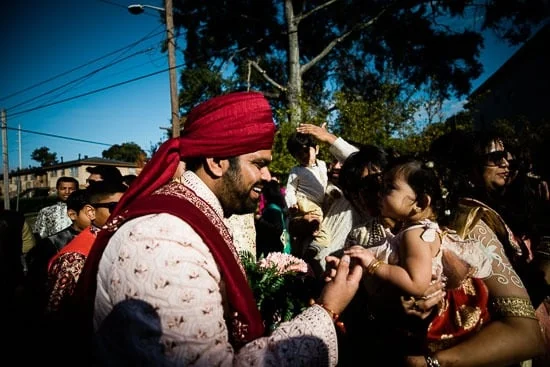
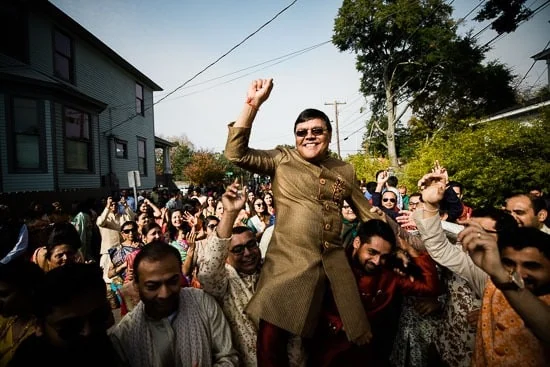
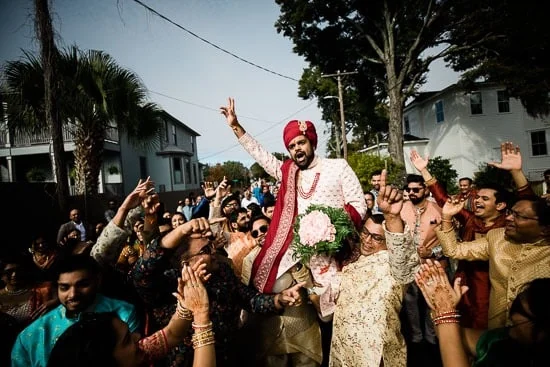
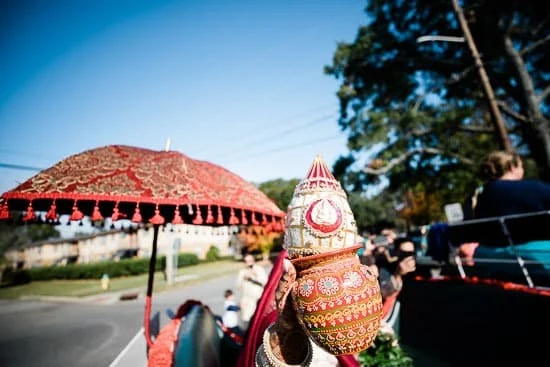
The baraat is the groom's wedding procession. In many North Indian, Punjabi and Gujarati families the groom rides a decorated horse, called a ghodi, or arrives in a car, while his family and friends dance ahead of him to a dhol drummer or a DJ. The procession ends at the ceremony venue, where the bride's family welcomes the groom's family.
The welcome changes by tradition. Punjabi families hold a milni, where relatives of the same standing on each side meet, embrace and exchange garlands. Many Hindu families perform an aarti and a tilak for the groom at the entrance. Gujarati families call the procession the jaan and the welcome the ponkhvu. In many Pakistani families the baraat is the groom's family arriving at the wedding hall for the nikah or reception, and the welcome is full of playful bargaining.
In The Middle Of It
The best baraat photographs come from inside the dancing, not from the sidewalk.
Horse, Car Or On Foot
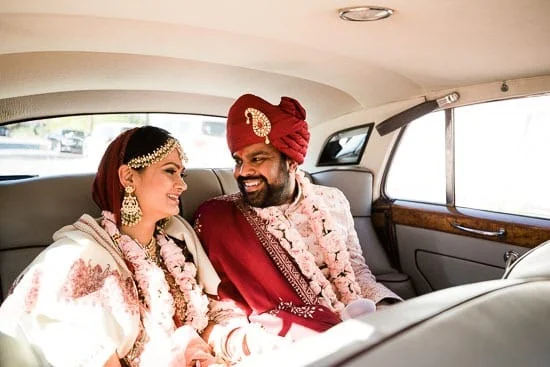
A horse is the classic choice, and it needs a vendor who brings the animal, a handler and a plan for where it waits. A vintage car or a convertible works well at hotels with a covered drive. Some baraats are simply on foot, with the groom in the middle of the dancing, which is the easiest to fit into a tight venue.
Whatever you choose, the venue decides the route. Chateau Elan says on its own page that its driveways and paths make a baraat route and that routes must be approved by resort management. Atlanta Marriott Marquis names baraat processionals in its Atrium Ballroom, an indoor option that ends any worry about the weather. The baraat rules and tips page has the questions to ask.
Planning The Route With The Venue
A baraat needs a path, a start, an end and permission. Hotels and resorts treat it as a moving event, and most want it planned weeks before the wedding. Start with the venue coordinator and walk the route together.
- Where does the groom's family gather, and is there shade or cover?
- How long is the route, and how long should the dancing last?
- Does the route cross a driveway, a public street or a parking deck?
- Where does a horse or a car wait, load and leave?
- Where do the two families meet for the milni or the welcome at the end?
- What happens if it rains?
Downtown and Midtown hotels in Atlanta sit on busy streets, so a baraat may need to stay on private drives, in a garage entrance or on a terrace. Resorts outside the city often have more room. Whatever the setting, get the approved route in writing and give a copy to the dhol player, the DJ, the horse handler and me.
The Dhol And The Music
The dhol is a double headed drum, and one good dhol player can carry a baraat on his own. Many Atlanta baraats pair a dhol player with a portable DJ cart or speaker. Ask the venue about volume, because hotels with other guests and resorts with neighbors may have limits on amplified sound outdoors.
Plan the playlist with whoever leads the dancing, often the groom's friends and cousins. Ask them to keep a lane open in the middle so the groom, the horse and I can all move forward.
The Milni And The Welcome
When the baraat arrives, the bride's family comes out to meet it. In many Punjabi and North Indian families this is the milni, where relatives of the same standing on each side greet each other, often with garlands and a warm embrace, sometimes with gifts. The two fathers meet, then the two uncles, and so on, and it can be a sweet and funny few minutes.
The bride's mother or another elder may then welcome the groom with an aarti, a small lamp circled in front of him, and a tilak on the forehead. In some families the bride's sisters and cousins block the door and ask for money before he is allowed in, a playful game that sets up the shoe stealing later.
Plan the milni right at the end of the route, with a little open space so both families can face each other. Tell your coordinator how many pairs will greet, so nobody is surprised by how long it takes, and make sure the garlands are ready before the dhol stops.
How A Baraat Usually Runs
- Gather
Groom Gets Ready
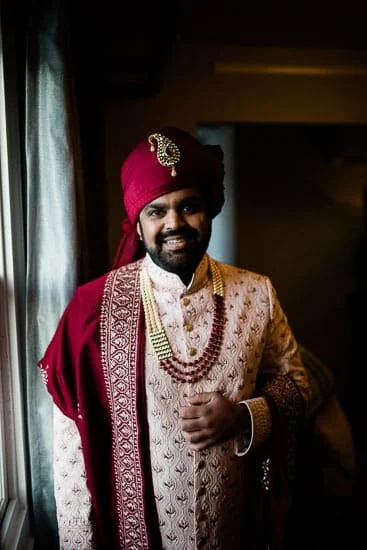
The groom finishes dressing, often with a sehra or a turban tied by family, and a few portraits.
- Start
Procession Begins
Family lines up behind the dhol, the groom mounts the horse or the car rolls out.
- Route
Dancing To The Door
The procession dances slowly to the ceremony entrance, usually thirty minutes or more.
- Arrival
The Welcome
Milni, aarti or ponkhvu with the bride's family, then everyone moves to the ceremony.
From Behind The Camera
How I Photograph And Film A Baraat
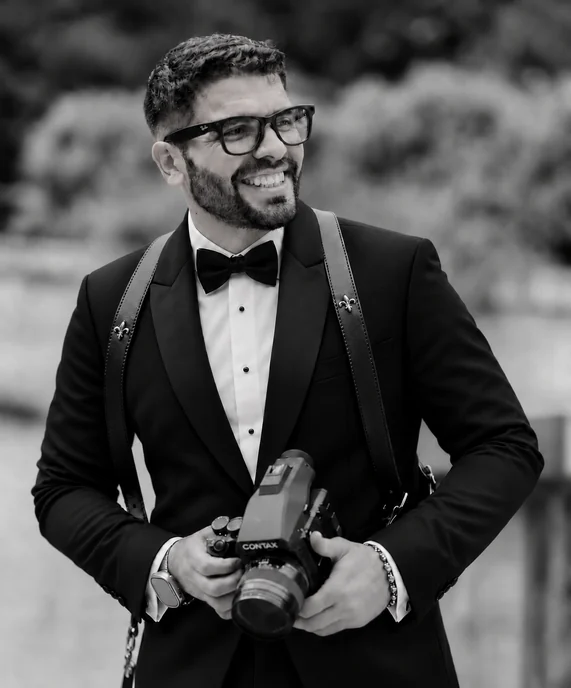
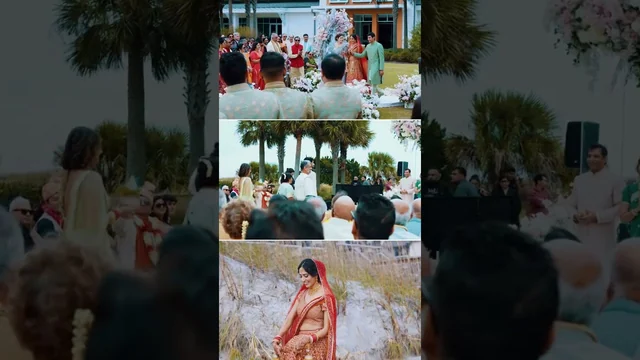
I start with the groom before he leaves, then walk backward in front of him for most of the route, with a second shooter or filmmaker covering the crowd and the families. The moment the groom is lifted by his friends happens fast, so I stay close. At the welcome I move to the bride's side, so we see both families meeting face to face.
In summer, ask everyone to finish the baraat before the hottest part of the afternoon. Heat makes for short tempers and wilted garlands.
Questions Couples Ask
How long does a baraat last?
Most run thirty to sixty minutes. Set a firm end time, because the ceremony start depends on it.
Do we need a horse?
No. A car or a procession on foot are both common. A horse needs a vendor, a handler and the venue's approval.
Can a baraat be held indoors?
Yes. Some hotels host the baraat in a ballroom or atrium. Atlanta Marriott Marquis names baraat processionals in its Atrium Ballroom.
Does the venue have to approve the baraat route?
Ask every venue. Chateau Elan, for example, publishes that routes must be approved by resort management.
What is a milni?
A Punjabi welcome where relatives of the same standing from each family meet, embrace and exchange garlands when the baraat arrives.
Check Your Date
Tell me the route and the start time, and I will be walking backward in front of the groom the whole way.